The Toyota Tsusho Group has set "Begin everything we do with ensuring safety and compliance, and continue to be an organization trusted by society" as one of its key Materialities. We conduct activities based on "Toyota Tsusho Group's Policies on Safety and Health" with the understanding that ensuring the occupational safety and health of not only Group employees but also contract employees, business partners, investors, and other related parties including contractors is of the utmost importance. We require that any incidents such as labor accidents or occupational hazards be reported to the designated contact point in accordance with our company-wide emergency reporting system, "Bad News First & Fast." Additionally, if deficiencies in the occupational health, safety, and environmental conditions affect the activities of internal or external stakeholders, we will encourage improvements based on this policy to the relevant parties.
Toyota Tsusho group recognizes that safety and health of group companies' Tsusho group will bring safety and health activity to effect to maintain safe and comfortable work environment.
May 20, 2025
President & CEO Toshimitsu Imai
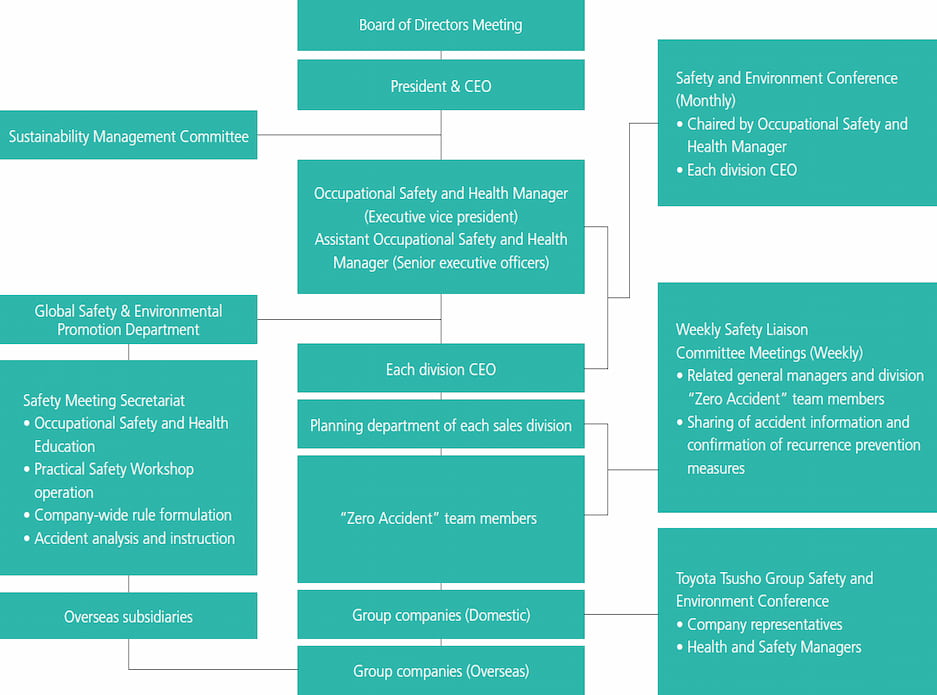
We strive to share safety information and raise safety consciousness, with the Weekly Safety Meeting and Global Safety & Environmental Committee at the core of our efforts.
Toyota Tsusho Corporation holds Weekly Safety Meetings attended by safety-related personnel, primarily members of "zero accident" teams in each division.
The company-wide Global Safety & Environmental Committee meets monthly to share information and improve safety awareness among top executives. It is chaired by the Executive Vice President, with divisional executives attending (Division CEO and directors in charge of "zero accident" promotion).
Under the supervision of the Board of Directors, the Toyota Tsusho Health and Safety Committee is chaired by the Chief Human Resources Officer (CHRO), who is responsible for health and safety. The committee meets monthly to discuss employee health and safety environments; it also reports to the Board of Directors on health and safety risks, depending on their severity. The Health and Safety Committee is also attended by a labor union officer, who acts as an employee representative. Together, the committee members discuss how to promote employee health, and how to develop environments in which it is easy to work.
Toyota Tsusho established the Safety Management Office in 1985 and the Environment & Safety Management Department in 2001 After the name change of the Safety Promotion Department; even after these were combined into the present-day Safety and Global Environmental Promotion Department in 2010, the company has striven to instill a culture of safety and eliminate and prevent accidents. Via plant safety diagnoses, occupational health and safety management systems, risk assessments, and other initiatives, we are promoting safety management activities at Group companies both in Japan and overseas. We are also focused on expanding the "Toyota Tsusho Global Safety Standard" as a common set of health and safety rules worldwide. Risk assessments are conducted as needed, such as when new tasks arise, when work processes change, for themes aimed at preventing similar accidents, and when introducing new equipment.
In the Occupational Safety and Health Management System (OSHMS), we have revised the content to comply with "ISO45001" from FY2022.
Top management and the head of each sales division personally visit business sites in Japan and overseas to conduct "factory inspections" and "construction safety inspections. In addition, we are striving to improve the level of safety and health management by checking the management system, the activities of the Safety and Health Committee, and the progress of the annual activity plan, conducting "risk assessments" to prevent accidents, and implementing a PDCA cycle to identify issues and implement countermeasures.
Of 383 companies subject to health and safety management, 15 or about 4% have received certification under ISO45001, international standards for occupational health and safety management. ISO 45001–certified companies are subject to an external audit at least annually.
In Japan, we have established the Toyota Tsusho Group Global Safety & Environmental Committee, to promote occupational safety and health activities at Toyota Tsusho and Group companies in Japan. The Committee is held every August and is chaired by the Executive Vice President, with representative directors of Group companies in Japan attending, and in the August 2024, a total of 299 people from 71 companies participated.
Planned internal audits under OSHMS, performed by health and safety officers, are conducted annually for domestic and overseas group companies. In addition, health and safety officers conduct annual, systematic internal audits based on OSHMS for domestic and overseas group companies. We also check the management structure, the status of Safety and Health Committee activities, and the annual activity plan's implementation status. Furthermore, we perform risk assessments in an effort to prevent accidents from occurring. We strive to improve our level of safety and health management by implementing the PDCA cycle to identify issues and implement countermeasures.
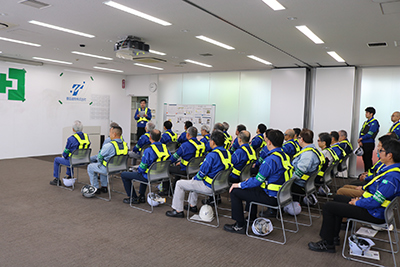
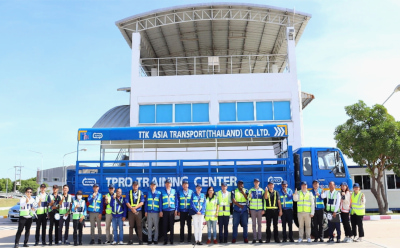
Overseas group companies also share the "Anzen First" ("Safety First") philosophy while promoting safety and health initiatives in accordance with local laws and regulations. In addition, we have been holding Global Safety Meetings since fiscal year 2012 with the aim of establishing a globally shared safety culture. The 13th meeting, held in fiscal year 2024 in Thailand in a hybrid format combining in-person and Zoom participation, brought together about 100 participants from 22 countries. Active discussions were held on themes such as the "2030 Safety Vision," "disaster analysis for this fiscal year," "OSHMS," "fire and explosion prevention activities," and "risk assessment." In addition, 11 local participants from France, Brazil, India, Singapore, the Philippines, and Malaysia visited three companies in Thailand to learn through on-site observation.
For suppliers, Toyota Tsusho Construction: Safety and Health Cooperation Council for equipment construction and the Toyota Tsusho Delivery Safety and Health Cooperation Council for transportation and delivery promote zero accident and zero occupational injury as well as improved safety and health management at each of our partner companies. The two councils have a combined membership of more than 600 companies, and strive to raise safety awareness through general meetings, safety conferences, and workshops.
Specifically, we support the safety and health activities of member companies by providing various types of safety and health education, such as training for persons in charge of operations, driver training sessions, and forklift training sessions, as well as holding lectures on safety and health. In fiscal year 2024, the training for persons in charge of operations (instructor training) was attended by 93 participants from 51 companies, and forklift training sessions were conducted four times with a total of 23 participants.
In addition, we disclose the In-house Safety Standards for Contractors to subcontractors involved in contracted construction work, require training for contractor workers and compliance with safety rules, and, together with the implementation of safety patrols, strive to ensure a safe working environment for the contractors as well.
We have distributed self-inspection sheets for preventing fires and explosions to 385 companies in Japan and overseas based on the "Fire and Explosion Prevention Policy" formulated by top management. The sheets are used to identify issues and prevent fires and explosions at each company.
Within the Toyota Tsusho Group, we have established the Emergency Response Guidelines (notifications) regarding communication systems and response policies in the event of an emergency. We also work together with the Compliance & Crisis Management Department and relevant divisions to respond in a timely and appropriate manner
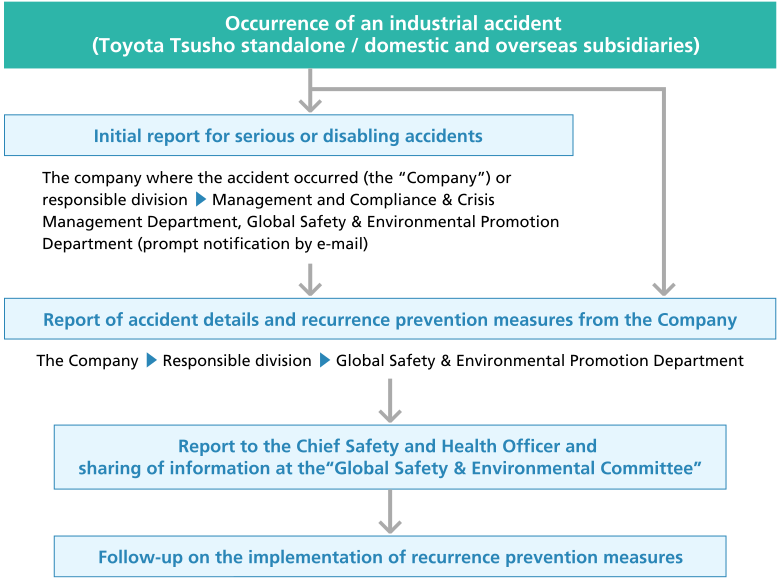
In addition, industrial accidents that occur within the Group are reported without delay through the accident reporting system (ASIST*) in accordance with the Toyota Tsusho Group Industrial Accident Reporting Standards. Root-cause analysis and recurrence prevention measures are disseminated across all departments and utilized to help prevent similar accidents.
Based on the idea that "the results of our daily safety activities lead to zero accidents," we incorporate specific activities based on an analysis of the details of accidents in the previous year and set annual targets to reduce the number of accidents and illnesses for all employees and contractors engaged by the Group.
We monitor the occurrence of industrial accidents with the targets of zero fatal accidents, zero disability accidents, and zero lost-time accidents. In fiscal year 2024 (April 2024-March 2025), there were zero fatal accidents, three disability accidents, and 64 lost-time accidents. The three disability accidents that occurred overseas were caused by entrapment, entanglement, and heavy objects. In response, we are striving to prevent recurrence by rechecking procedures for responding to equipment abnormalities, reviewing work procedures, and thoroughly disseminating the lessons learned from these accidents globally to the Toyota Tsusho Group’s front-line workplaces.
At our investment businesses, we conduct occupational health and safety inspections at the planning stage of construction projects.
With regard to investment projects that involve construction of which the contribution rate is 50% or more, the occupational health and safety standards for risk assessment of new and existing business are expressly stated, the existence of a safety management system is confirmed by conducting audits throughout the construction implementation cycle starting from the planning stage, and measures are taken to reduce occupational health and safety risks.
The Safety Management Group strives to fulfill its duty as a safety-conscious contractor by ensuring that construction projects are completed without accidents or disasters, and seeing that the five elements of the safe construction cycle are functioning smoothly.
Based on the idea that the starting point of safety management is human resource development, the Toyota Tsusho Group conducts various safety and health educational programs for Group employees as well as suppliers in accordance with "Toyota Tsusho Group's Policies on Safety and Health."
We explain our policies on safety and health to employees and provides basic education on safety and health management. In addition to safety education (e-Learning) for all employees and "2S (Sunflower) Activities" in which all employees participate, various information is disseminated domestically and internationally via the Group intranet "ANZEN-NET," including activity policies, accident case studies and good practices, and safety education videos.
In fiscal year 2024, a total of 2,021 employees completed E-Learning courses on office safety. Additionally, individual training sessions were conducted as follows: 70 participants in new employee orientation, 52 in career employee onboarding, 176 in pre-departure training for overseas assignments, and 235 in the Practical Safety Workshop.
At domestic subsidiaries, we regularly provide legal training such as safety management training for new managers and training to become a foreman who directs and supervises workers at a work site to raise awareness of safety and health at work sites and prevent accidents. In fiscal year 2024, 66 employees participated in safety management training for new managers, 100 employees participated in training to become a foreman, and 352 employees participated in the Practical Safety Workshop.
The instructors who lead these health and safety programs understand conditions in the Toyota Tsusho Group and have been trained internally to respond to on-site circumstances. All instructors are qualified as "RST Trainers," which is an instructor qualification for safety and health education approved by the Ministry of Health, Labour and Welfare, and as "Specialized Instructors for All Toyota Work Supervisors," which is an instructor qualification for safety and health supervisor education in the Toyota Group.
We also provide information to the front lines of the workplace globally via safety and health-related personnel in Japan and overseas and the Group intranet to help prevent accidents, including safety awareness posters, 18 ironclad rules to prevent (STOP6*) accidents, and examples of past accidents.
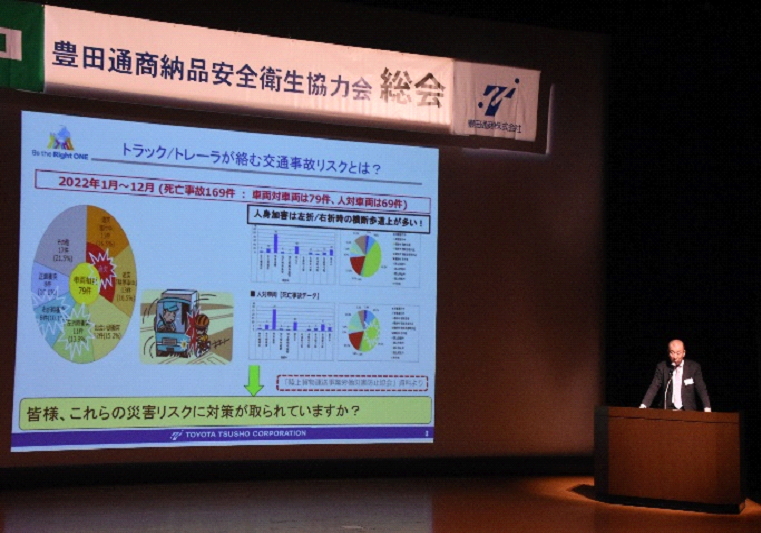
Toyota Tsusho Delivery Safety and Health Cooperation Council general meeting
We provide safety and health education for suppliers, and regularly conduct various types of education for logistics delivery companies and construction workers at the Toyota Tsusho Construction: Safety and Health Cooperation Council and the Toyota Tsusho Delivery Safety and Health Cooperation Council as activities to ensure safety throughout the supply chain. In fiscal year 2024, 400 employees from 339 suppliers participated in top management training, in which lectures on safety and health were given by outside instructors, and 131 employees from suppliers participated in the Practical Safety Workshop.
At our overseas subsidiaries, safety staff at each company provide education to foremen at worksites. In fiscal year 2024, 37 overseas safety staff members also received training at the Practical Safety Workshop, and we are making efforts to improve safety and health education at local sites.
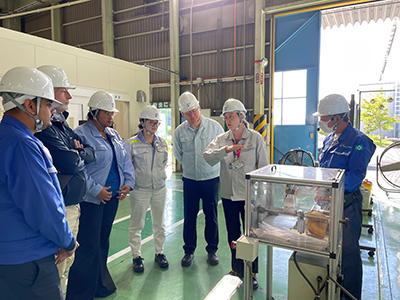
In 2009, we established Practical Safety Workshop to develop human capital who can physically experience and learn the fear of hazards, enhance their sensitivity to danger, and carry out practical safety management. The workshop is an educational tool that utilizes VR technology and 60 different types of experiences, with a focus on "STOP6 accidents*" such as getting caught between or entangled in heavy objects, in which a single mistake can lead to a serious accident. The workshop is used not only by Toyota Tsusho Group employees globally, but also by a wide range of our business partners.
Over 11,871 people have used the workshop since its establishment, with 755 people using it in the fiscal year 2024.
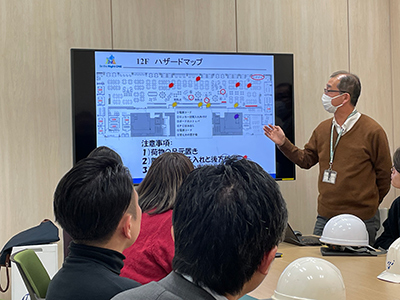
As a trading company, much of Toyota Tsusho's work takes place in offices. For this reason, in the fiscal year ended March 31, 2017, we began conducting Office Safety Workshops and taking measures to raise awareness of safety with regard to office work. In the fiscal year 2023, approximately 100 employees, including those from Group companies, took the course. To date, over 1,000 people have attended, including Group company employees.
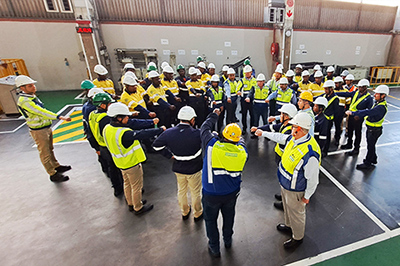
Every year, we hold a "Fatal Accident Memorial" on days when fatal accidents occur at Group companies to renew our commitment to eliminating accidents.
The Toyota Tsusho Group has been disseminating safety and health information on the Group intranet (ANZEN-NET) since 2009. We regularly make changes to the design and enhance the content. In 2016, we introduced the ASIST* accident reporting workflow system to promote the sharing of information among all concerned parties on a global basis.
In addition, we set up a "Zero Accident Corner" in our Nagoya Head Office to serve as a base for Toyota Tsusho's global safety activities.
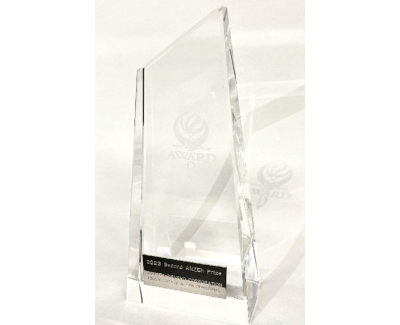
Each year, we recognize and commend Group companies for their record of continuous zero accidents and for their outstanding safety and health initiatives, thereby raising global safety awareness and sustaining motivation for activities.
