Based on our mission of "passing on a better Earth to the children of the future", the Toyota Tsusho Group envisions becoming a Leading Circular Economy Provider and has established the Toyota Tsusho Group Environmental Policy.
Under this policy, we are promoting initiatives such as responding to climate change, preserving forests and biodiversity, conserving resources, reducing energy consumption and improving efficiency, using water effectively, and reducing water consumption in areas experiencing water stress.
We regularly review the policy in response to changes in the business environment and market expansion, taking into consideration feedback obtained through consultation with external stakeholders, including NGOs. The Sustainability Committee, chaired by the CEO, approves both the establishment and any revisions, and the results are reported to the Board of Directors.
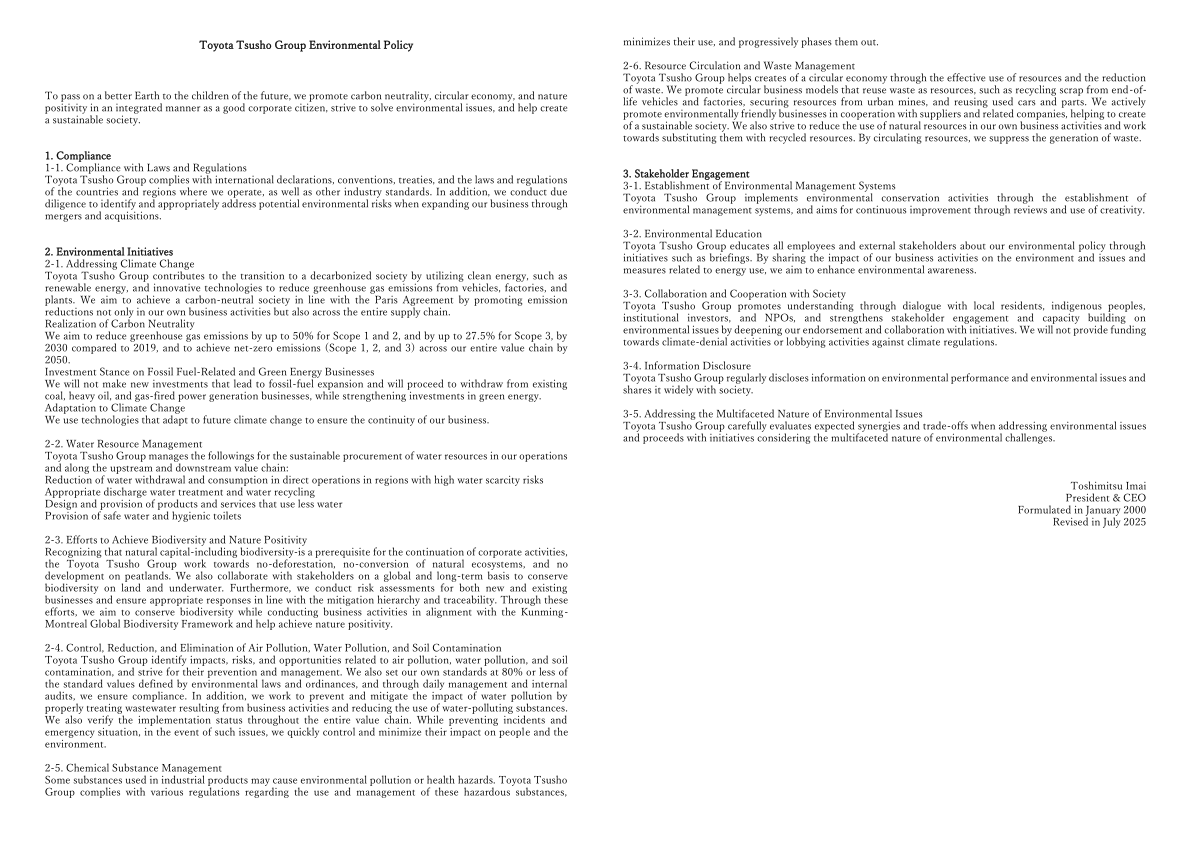
Under the supervision of the Board of Directors, the Toyota Tsusho Group promotes environmental management through the Sustainability Committee, the Safety and Environmental Conference, and the Carbon Neutrality Promotion Meeting.
The Sustainability Committee makes decisions based on status reports regarding initiatives addressing overall ESG-related materiality. The Safety and Environmental Conference reviews the progress of environmental targets and compliance with laws and regulations, while the Carbon Neutrality Promotion Meeting focuses on initiatives related to climate change issues. Under this cross-functional environmental management promotion structure, decisions are made through discussions from various perspectives and are reflected in the business strategies of each sales division.
In addition, the Toyota Tsusho Group has introduced an environmental management system. In Japan, the system conforms to ISO 14001 standards, while overseas operations are managed based on an internally developed Environmental Management Rulebook - a set of voluntary standards.
Based on ISO 14001 and our own standards, we evaluate and correct our environmental management system through regular internal audits and external audits by third-party auditing organizations, and we work to achieve continuous improvement by implementing the PDCA cycle.
The Toyota Tsusho Group holds an annual Global Safety & Environmental Promotion Meeting to report on the Group's environmental conservation activities, communicate changes to laws and regulations, and to share information. As far as environmental accidents are concerned, a Safety Management Enhancement Committee-attended by executives-is held once a month, and reports of case studies and countermeasures are shared to prevent reoccurrences.
The Toyota Tsusho Group passed its ISO 14001:2015 certification renewal audit in 2025, and its current certification is effective until December 31, 2027.
The number of Group business subsidiaries that have acquired ISO 14001 certification stands at 204, of which 160 subsidiaries acquired the certification for their manufacturing sites (representing an acquisition ratio of 89.3% among manufacturing sites).
In addition, even for companies that have not obtained ISO 14001 certification, all manufacturing sites have introduced environmental management based on the Environmental Management Rulebook-a set of voluntary standards-and have established an audit and verification system reflecting these standards (representing an introduction ratio of 100% among manufacturing sites).
As part of our efforts based on the Toyota Tsusho Group Environmental Policy, we implement environmental risk management through environmental due diligence, investment and financing reviews, and other related processes.
We conduct ongoing environmental due diligence for existing business operations, including our own direct operations, as part of our comprehensive risk management activities (Check10). Through these activities, we regularly assess the effectiveness of environmental risk responses and the status of environmental management systems, while continuously enhancing management capabilities.
For our supply chain, we conduct environmental due diligence based on the Toyota Tsusho Group Environmental Policy. This includes supplier risk assessments from the perspectives of climate change, pollution, water resources, biodiversity, and waste management.
Based on the Toyota Tsusho Group Environmental Management System, which conforms to ISO 14001, we evaluate compliance with environmental laws and regulations every six months. In addition, we conduct double-checks through internal audits and external audits by third-party auditing organizations, while quantitatively evaluating the level of environmental pollution risk associated with individual facilities and the management level of operational sites. Through these measures, we promote the prevention and reduction of environmental pollution risks as well as waste reduction.
Before making investment decisions, we use an Environmental Checklist to identify and assess environmental impacts, including potential effects on biodiversity and water resources. Based on the assessment results, we implement necessary mitigation measures and proceed with projects accordingly.
Our due diligence activities are continuously advanced taking into consideration the views and expectations of stakeholders, including Japan's Ministry of the Environment.
| Toyota Tsusho (non-consolidated) | Japanese Group Companies | |
|---|---|---|
| First-party audit (internal) | 36 departments | 70 companies |
| Second-party audit (internal) | 0 department | 17 companies |
| Third-party audits (external) | 36 departments | 2 companies |
In addition, we widely collect various types of environmental data, such as those related to climate change and water resources, from our domestic and overseas group companies. By analyzing and evaluating this data—including performing year-over-year comparisons—we identify opportunities to improve energy performance and strive to preserve the environment and reduce environmental impact.
Specifically, we track energy efficiency data, including GHG emissions and energy consumption, across all of our sites. We analyze energy efficiency and consumption based on the unique circumstances of each site, such as the types of energy used and facility configurations. Based on these analyses, we establish energy management standards for each site, striving to reduce GHG emissions and promote energy conservation.
Furthermore, we review and analyze data concerning the efficient use of water, such as water withdrawal and water usage volumes, to identify sites with high water withdrawal/usage and activities that impact water quality. Based on these analyses, we maintain and manage our wastewater treatment facilities on a regular basis. We also strictly manage and monitor the concentration of pollutants in wastewater based on our voluntary standards, working to ensure the sustainable use of water resources and improve water efficiency.
We use e-learning and Environment Month to raise the environmental awareness of employees of the Company and Group companies. E-learning programs on ISO 14001 standards and the environment are available on the Group intranet, Specifically, those focus on a wide range of environmental issues such as the Toyota Tsusho Group's Environmental Policy, various environmental laws and regulations including biodiversity, water resource and waste reduction to help employees enhance their environmental knowledge and awareness.
| Contents | Implementation period | Number of participants |
|---|---|---|
| Environmental Risk Management Training (Soil Contamination, Air Pollution, and Water Pollution) | April 2025 to March 2026 | 1,310 persons |
| Nature Positive seminar | April 2025 to March 2026 | 185 persons |
In Japan, the Group undertakes environment management through environmental management systems compliance with ISO 14001 and holds various e-learning for Group employees.
| Contents | Number of participants |
|---|---|
| ISO14001 seminar for executives | 300 persons |
| Pre-assignment training for new expats (environmental preservation) | 37 persons |
