Toyota Tsusho has embraced the mission of "passing on a better Earth to the children of the future" and aims to "Be the Right ONE"—an irreplaceable, one-and-only presence. We have established our "Behavioral Guidelines" as a fundamental code of conduct for realizing this mission. Furthermore, to pass on and evolve the "Toyota Tsusho DNA"—which articulates the unique values, beliefs, and principles of day-to-day conduct cherished by our Group—while promoting value creation from a customer perspective and fulfilling the social mission of the Toyota Tsusho Group, we have set forth the "Basic Policies on Establishing Internal Control Systems." Based on these basic policies, we will actively drive forward with efforts to further improve management efficiency and transparency, ensure full-fledged compliance, and enhance the soundness of our financial position. In addition, we will further enrich our public relations and investor relations (IR) activities to foster a broader understanding of our Group among all stakeholders.
Download for All Pages in PDF format
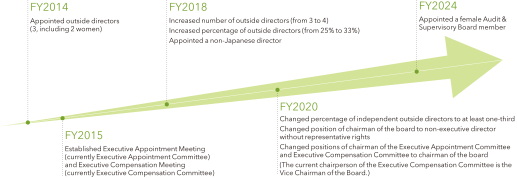
Toyota Tsusho has adopted the system of a company with an Audit & Supervisory Board to ensure transparent and sound management and has also introduced an executive officer system to improve management efficiency and strengthen internal control.
The company carries out consolidated management based on a divisional organization that comprises eight sales divisions under the leadership of divisional chief executive officers (CEOs) supplemented by the Administrative Unit.
To enhance independence from the execution of the company’s operations, a non-executive director serves as chairman of the board. At least one-third of the members of the board are independent outside members to strengthen the soundness of management and the functioning and quality of the board, which makes decisions on top-priority management issues and monitors the execution of business. The five outside members of the board (outside directors) include an overseas national and a business entrepreneur, ensuring a continued high level of specialized knowledge, while the inclusion of three female members also contributes to enhancing its diversity.
The division CEOs and the heads of the various Administrative Unit functions are appointed from among the senior executive officers to enable fast-paced management that is in close contact with frontline operations. To boost expertise, we have established the positions of Chief Financial Officer (CFO), Chief Strategy Officer (CSO), Chief Compliance and Administration Officer (CCAO), Chief Technology Officer (CTO), Chief Safety & KAIZEN Officer (CSKO),and Chief Human Resources Officer (CHRO), who bear ultimate responsibility for their respective functions. By reinforcing governance functions and clarifying roles and responsibilities, this facilitates the exercise of high levels of specialization and expedites decision-making.
Toyota Tsusho expressed its support for the "Challenge for 30 percent by 2030" promoted by the Japan Business Federation (Keidanren). This challenge sets a target of filling at least 30% of positions on the Board of Directors, a key corporate decision-making body, with women by 2030.
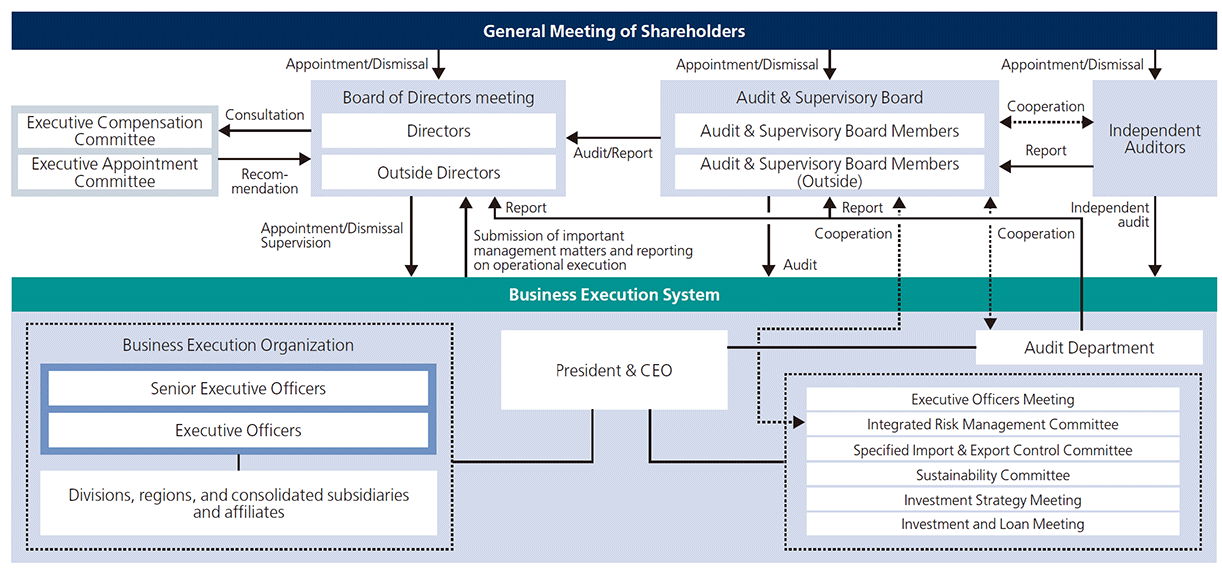
The Board of Directors meeting, which comprises ten members, including five outside members, makes decisions on top-priority management issues and monitors the execution of business. The company has submitted notification that four of the five outside members of the board satisfy the criteria for independence as specified by Japanese stock exchanges. Moreover, the independence of the Board of Directors meeting is enhanced by having a non-executive director serve as chairman. Members of the board are appointed for a one-year term, and the Board of Directors meeting in principle meets once a month.
| Topic | Main Resolutions and Reports |
|---|---|
| Management Strategy / Key Management Issues |
|
| Investments and Loans (Including progress reports on each business) |
|
| Corporate-Related Matters / Others |
|
Toyota Tsusho will pursue its “Be the Right ONE” vision to shape the future. By doing so it aims to create distinctive forms of value that contribute to society and protect the environment and thereby establish business domains linked to its unique strengths. Toward this goal, the Board of Directors meeting has established a skill matrix covering the expertise required of members of the Board and Audit & Supervisory Board members to enable the Board of Directors meeting to make decisions and supervise management appropriately.
The capabilities and experience of board and Audit & Supervisory Board members are as below.
In addition to their expertise and wealth of experience, the Board of Directors meeting boasts a diverse composition in terms of gender, nationality, and other attributes, providing a structure that can flexibly adapt to various changes in the business environment.
| Required skills | Reasons for the selection of these skills |
|---|---|
| Business management | Experience involving corporate management is required in order to make proper management decisions for the consistent growth of corporate value as the business climate changes rapidly. |
| Global | The Toyota Tsusho Group operates in more than 130 countries and regions. Consequently, extensive knowledge and experience involving job postings in other countries and life styles, culture, business climates and other aspects of other countries are required. |
| Sales/Marketing | The Toyota Tsusho Group must accurately identify and meet a broad range of customer needs as a trading company handling many types of products. This requires sales and marketing expertise along with a thorough understanding of numerous markets. |
| Finance/Accounting | Knowledge and experience involving finance and accounting are required in order to make strategic investments for sustained growth and other goals while using capital more efficiently and preserving financial soundness. |
| Legal/Risk management | Expertise and experience involving legal affairs and risk management are required for the purposes of maintaining corporate governance for sustained growth and the medium to long term growth of corporate value and of establishing a risk management framework for supporting business operations, including activities in emerging countries in Africa and other regions. |
| Technology/Digital | Knowledge and experience involving new technologies and services, including information technology and the digital transformation, are required in order to benefit from advances in technologies, especially in the field of mobility. |
| Sustainability | Sustainability is an integral component of management at the Toyota Tsusho Group. Knowledge and experience are required concerning ESG issues and for achieving the sustained growth of corporate value from a long term perspective. |
| Name | Position | Business management | Global | Sales/ Marketing |
Finance/ Accounting |
Legal/Risk management | Technology/ Digital |
Sustainability | ||
|---|---|---|---|---|---|---|---|---|---|---|
| Members of the Board | Internal | Nobuhiko Murakami | Chairman of the Board | 〇 | 〇 | 〇 | 〇 | |||
| Ichiro Kashitani | Vice Chairman of the Board | 〇 | 〇 | 〇 | 〇 | |||||
| Toshimitsu Imai | President & CEO* | 〇 | 〇 | 〇 | 〇 | 〇 | ||||
| Hideyuki Iwamoto | Member of the Board* | 〇 | 〇 | 〇 | 〇 | 〇 | ||||
| Tatsuya Watanuki | Member of the Board* | 〇 | 〇 | 〇 | 〇 | 〇 | ||||
| Outside | Didier Leroy | Outside Member of the Board | 〇 | 〇 | 〇 | 〇 | ||||
| Yukari Inoue | Outside Member of the Board | 〇 | 〇 | 〇 | 〇 | |||||
| Chieko Matsuda | Outside Member of the Board | 〇 | 〇 | 〇 | 〇 | 〇 | ||||
| Goro Yamaguchi | Outside Member of the Board | 〇 | 〇 | 〇 | 〇 | 〇 | ||||
| Yuki Isogai | Outside Member of the Board | 〇 | 〇 | 〇 | 〇 | |||||
| Audit & Supervisory Board members | Internal | Kentaro Hayashi | Audit & Supervisory Board member (full time) | 〇 | 〇 | 〇 | 〇 | |||
| Kazuya Kawashima | Audit & Supervisory Board member (full time) | 〇 | 〇 | 〇 | ||||||
| Outside | Tsutomu Takahashi | Outside Audit & Supervisory Board member |
〇 | 〇 | 〇 | |||||
| Seishi Tanoue | Outside Audit & Supervisory Board member |
〇 | 〇 | 〇 | ||||||
| Rikako Beppu | Outside Audit & Supervisory Board member |
〇 | 〇 | 〇 | ||||||
| Name/Reason for appointment | Attendance at Board of Directors meetings (Fiscal Year ending March 2026) |
|
|---|---|---|
| Members of the Board |
Nobuhiko Murakami Mr. Nobuhiko Murakami has served as an officer for Toyota Motor Corporation and SUBARU Corporation, and was mainly engaged in global management and marketing. He has expertise in the automobile industry, with a wealth of experience in global management. The Company has nominated Mr. Murakami as a director based on the belief that he can provide advice about the Company’s businesses and supervise the execution of duties by directors by using a viewpoint separate from that of managers of business operations after he became Chairman of the Board in June 2022. |
13/13 |
| Ichiro Kashitani Mr. Ichiro Kashitani has experience in the automotive, food, Africa, corporate and other business units and had been President & CEO for seven years since April 2018. His outstanding management skills and leadership have made a big contribution to the growth of corporate value. He has a wealth of experience in global management and advanced knowledge of overall management. By using these skills, he is expected to provide advice about business operations and supervise the execution of duties by directors from a viewpoint that is separate from the management of business operations. For these reasons, the Company has nominated him as a director. |
13/13 | |
| Toshimitsu Imai Mr. Toshimitsu Imai has been involved primarily with the mobility business and has experience as the vice president of CFAO, Managing Officer (Chief Executive Officer, Africa Division) of Toyota Motor Corporation, and COO of the Africa Division of Toyota Tsusho, where he played a key role in business operations in Africa. Subsequently, he was the executive vice president and CTO of Toyota Tsusho and was named President & CEO in April 2025. Mr. Imai has advanced knowledge of overall management backed by many years of experience concerning global management. He is expected to use these skills to contribute to the growth of corporate value. For these reasons, the Company has nominated him as a director. |
10/10 | |
| Hideyuki Iwamoto Mainly engaged in accounting, finance and corporate planning fields at the Company, Mr. Hideyuki Iwamoto has served as CFO since April 2019. The Company has nominated Mr. Iwamoto as a director because he has a wealth of experience in global management and has advanced knowledge of overall management, particularly in the fields of finance, accounting, and risk management, and is able to contribute to the enhancement of the Company’s corporate value. |
13/13 | |
| Tatsuya Watanuki Mr. Tatsuya Watanuki was initially assigned to the electronics sector and subsequently was vice president of the India subsidiary and Regional CEO of East Asia Region. He was named executive vice president and Lifestyle Division CEO in April 2024. Mr. Watanuki has advanced knowledge of overall management backed by many years of experience concerning global management. He is expected to use these skills to contribute to the growth of corporate value. For these reasons, the Company has nominated him as a director. |
10/10 | |
| Outside Members of the Board |
Didier Leroy Mr. Didier Leroy has served as a director of Toyota Motor Corporation and its affiliate. He has a wealth of experience in corporate management and advanced expertise in the global business operations, particularly in the automobile industry. The Company has nominated Mr. Leroy as a director due to the belief that he can use his experience and expertise to provide advice on the overall business operations and management of the Company and to supervise the performance of the directors. |
13/13 |
| Yukari Inoue Ms. Yukari Inoue has served as an executive at global companies, including her current position as President & CEO of Kellogg Japan G.K. She has a wealth of corporate management experience and advanced expertise in global business operations, particularly businesses concerning consumer products. The Company has nominated Ms. Inoue as a director due to the belief that she can use her experience and expertise to provide advice on the overall business operations and management of the Company and to supervise the performance of the directors. |
13/13 | |
| Chieko Matsuda Ms. Chieko Matsuda has experience at a bank and credit rating agency as well as in the field of research and as an outside director of an operating company. She has a wealth of experience and advanced expertise particularly in corporate management, finance and corporate governance. The Company has nominated Ms. Matsuda as a director due to the belief that she can use her experience and expertise to provide advice on the overall business operations and management of the Company and to supervise the performance of the directors. |
13/13 | |
| Goro Yamaguchi Mr. Goro Yamaguchi has a wealth of corporate management experience that includes positions as President and Representative Director and Chairman of the Board of KYOCERA Corporation, a major manufacturer of electronic components and devices. He also has advanced expertise concerning global business operations, particularly in the field of electronics. The Company has nominated Mr. Yamaguchi as a director due to the belief that he can use his experience and expertise to provide advice on the overall business operations and management of the Company and to supervise the performance of the directors. |
13/13 | |
| Yuki Isogai For many years, Ms. Isogai has been involved with sustainability management in Japan and other countries at private-sector companies, international organizations and consulting firms. As a partner in charge of the Africa Desk at the PwC Japan Group, she supported activities of Japanese companies expanding into the markets of Africa and provided consulting services concerning circular economy businesses as a lead partner for sustainability services. She is currently the Representative Director and CEO of Earth Nest LLC, where she is involved with sustainability management activities and support. Ms. Isogai has extensive experience and specialized knowledge in the field of sustainability. The Company has nominated Ms. Isogai as a director due to the belief that she can use her experience and expertise to provide advice on the overall business operations and management of the Company and to supervise the performance of the directors. |
ー |
Toyota Tsusho evaluates the effectiveness of the Board of Directors meeting annually to continue to maintain and improve the effectiveness of its corporate governance.
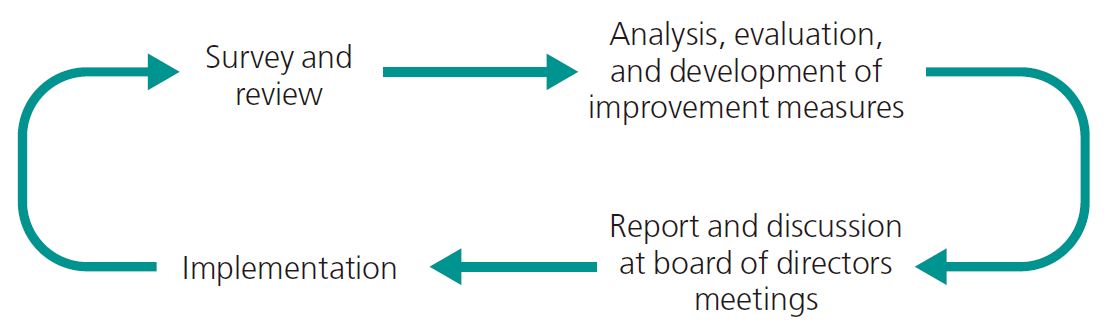
| Respondents | All eight members of the board and all five Audit & Supervisory Board members |
|---|---|
| Priority Topic | Further improvement of the effectiveness of the board of directors meetings |
| Evaluation items |
|
Questionnaire responses were generally positive across all of the matters evaluated, confirming the effectiveness of the Board of Directors meeting.
| Issues to Address | Major Initiatives | |
|---|---|---|
| Enhancement of reporting and discussion related to major risks |  |
|
| Expansion of reporting scope and discussion related to human capital | Reporting and discussion of human capital management and human rights due diligence initiatives at the Board of Directors meeting | |
| Reporting on progress of reforms resulting from organizational restructuring and provision of information related to business outlooks | Reports and discussions incorporating these elements are conducted in dialogue meetings between outside directors/auditors and the sales division | |
| Expansion of information sharing related to IR activities | Regularly distributing analyst reports and minutes of investor meetings to outside directors/auditors to share direct investor feedback |
| Issues to Address | Proposed Responses | |
|---|---|---|
| Enhancing discussions on management issues such as the allocation of management resources | |
Establish a forum at the Board of Directors to discuss management issues such as company-wide management strategy, human resources, risk management, and sustainability, and provide timely reports and discussions when significant environmental changes arise that may impact business operations |
| Reviewing the operation of the Board of Directors meeting, including time allocation and meeting materials | Allocate appropriate time based on agenda items and ensure consistency of discussion points by organizing necessary information for board materials through the board secretariat | |
| Revising the criteria for submitting matters to the Board of Directors meeting. | Consider raising the monetary threshold for important matters, in accordance with the company’s size, to allow for focused deliberation on key issues |
We are reviewing the agenda of the Board of Directors so that the Board serves not only as a body for approving and receiving reports on individual matters, but also as a forum for discussing management issues and company-wide strategies. Board members engage in multifaceted discussions on important themes related to the Company’s business environment and future growth, including the medium-term management plan, human capital management, promotion of digital transformation (DX), investor relations (IR), and corporate governance. In addition, in order to devote more time to discussions on these important themes, the Company significantly raised certain thresholds in the criteria for matters to be submitted to the Board of Directors, effective from April 2026. By further enhancing the substance of management discussions, we aim to increase corporate value through strengthening the effectiveness of the Board of Directors.
To enable outside directors to fully perform their advisory and supervisory functions, materials for Board meetings are distributed earlier, and the secretariat for the Board of Directors, together with the relevant proposing departments, provides advance briefings prior to each meeting. Through this support system, outside directors are able to participate in Board discussions with a sufficient understanding of the business matters to be discussed.
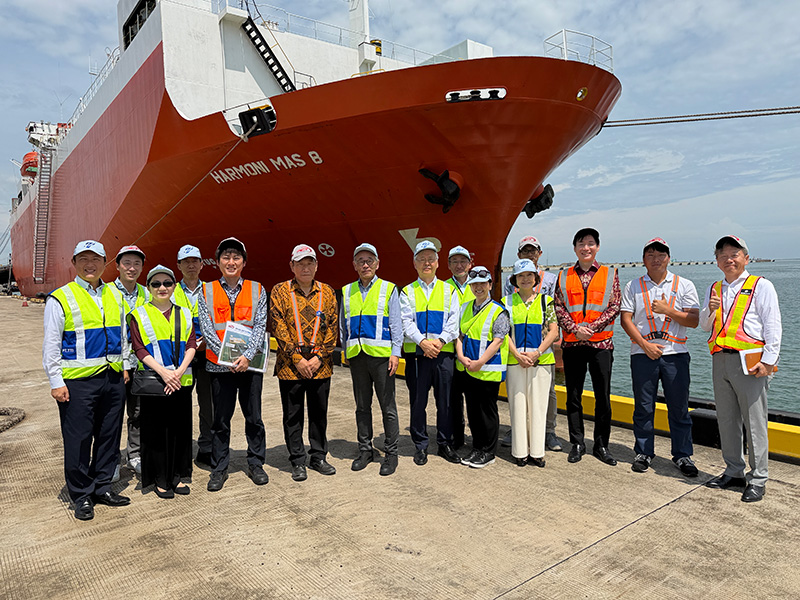
To provide opportunities for outside directors and Audit & Supervisory Board members to deepen their understanding of the Company’s businesses, site visits are conducted at business locations in Japan and overseas. Through these visits, they directly confirm the status of operations on the ground and the actual conditions of the business, and the insights gained through dialogue with local management and employees are reflected in discussions at Board of Directors meetings.
Toyota Tsusho has established the Executive Appointment Committee and the Executive Compensation Committee as advisory bodies to the Board of Directors meeting. Both committees are chaired by the Chairman or Vice Chairman of the Board, who has no involvement in operational execution. Each committee comprises six members—four independent outside members of the board and two internal members of the board. The majority of each committee being made up of independent outside members of the board enhances the objectivity and transparency of each committee.
The Executive Appointment Committee deliberates on the appointment and dismissal of members of the board and, Audit & Supervisory Board members and senior executive officers. It also discusses proposed executive personnel plans, as well as the formulation and operation of CEO successor development plans and other important matters related to executive appointments. The Executive Compensation Committee deliberates on the policy for determining the details of compensation for each member of the board, the compensation system, compensation proposals to be submitted to the General Meeting of Shareholders, and other important matters concerning the compensation of members of the board and Audit & Supervisory Board members.
| Executive Appointment Committee | Executive Compensation Committee | |
|---|---|---|
| Committee Chairman | Nobuhiko Murakami (Chairman of the board) | Ichiro Kashitani (Vice Chairman of the Board) |
| Committee member | Toshimitsu Imai (President & CEO) | Toshimitsu Imai (President & CEO) |
| Committee member | Yukari Inoue (Outside member of the board) | Yukari Inoue (Outside member of the board) |
| Committee member | Chieko Matsuda (Outside member of the board) | Chieko Matsuda (Outside member of the board) |
| Committee member | Goro Yamaguchi (Outside member of the board) | Goro Yamaguchi (Outside member of the board) |
| Committee member | Yuki Isogai (Outside member of the board) | Yuki Isogai (Outside member of the board) |
The Audit & Supervisory Board, which comprises five members (three of whom are independent outside Audit & Supervisory Board members), provides a checking function from an external viewpoint. All Audit & Supervisory Board members regularly exchange opinions with board members, including outside members of the board, executive officers, and an independent auditor, as well as with the Audit Department and other entities. In this way, Audit & Supervisory Board members strive to ensure the legality, appropriateness, and efficiency of business execution. The Audit & Supervisory Board meets in principle once a month. Audits conducted by Audit & Supervisory Board members are carried out per the audit policies and plans approved by the Audit & Supervisory Board and reported to the Board of Directors meeting. Audit & Supervisory Board members implement audits on the execution of duties by members of the board. An audit is also conducted regarding the appropriateness of the results of the inspection by the independent auditor. Dedicated staff members are assigned to assist with the duties of Audit & Supervisory Board members, including outside auditors.
| Name/ Reason for appointment |
Attendance at Board of Directors meetings (Fiscal Year ending March 2026) |
Attendance at Audit & Supervisory Board meetings (Fiscal Year ending March 2026) |
|
|---|---|---|---|
| Audit & Supervisory Board Members | Kentaro Hayashi Mr. Kentaro Hayashi served as General Manager of the ERM Department and as Senior Vice President and CFO at the local subsidiary in the US, and has extensive experience and advanced knowledge of risk management, accounting, and finance. The Company has nominated Mr. Hayashi as an Audit & Supervisory Board Member because it believes he is capable of appropriately supervising the execution of duties by directors of the Company from an independent and neutral standpoint as a full-time Audit & Supervisory Board Member. |
13/13 | 14/14 |
| Kazuya Kawashima Mr. Kazuya Kawashima has been involved mainly in legal field and has experience as the manager for overseas subsidiary compliance and as General Manager of the Legal Department. Subsequently, he was the full-time Audit & Supervisory Board member of a subsidiary. He has many years of experience and advanced knowledge in the fields of corporate legal affairs, risk management and compliance. The Company has nominated Mr. Kawashima as an Audit & Supervisory Board Member because it believes he is capable of appropriately supervising the execution of duties by directors of the Company from an independent and neutral standpoint as a full-time Audit & Supervisory Board Member. |
10/10 | 10/10 | |
| Outside Audit & Supervisory Board Members | Tsutomu Takahashi Mr. Tsutomu Takahashi has served for many years as a certified public accountant and served in key positions at KPMG AZSA LLC. He has a wealth of experience and advanced expertise in corporate accounting, corporate audit and compliance. The Company has nominated Mr. Takahashi as an outside Audit & Supervisory Board Member because of his current role in which he appropriately supervises the execution of duties of the directors of the Company from an independent and neutral standpoint as an outside Audit & Supervisory Board Member. |
12/13 | 13/14 |
| Seishi Tanoue Mr. Seishi has served as President of a U.S. subsidiary, General Manager of the Management Audit Department, and Full-time Audit & Supervisory Board Member at Toppan Inc. (currently TOPPAN Holdings Inc.). He has a wealth of experience and advanced expertise in global corporate management and auditing. The Company has nominated Mr. Tanoue as an outside Audit & Supervisory Board Member because of his current role in which he appropriately supervises the execution of duties of the directors of the Company from an independent and neutral standpoint as an outside Audit & Supervisory Board Member. |
13/13 | 14/14 | |
| Rikako Beppu Ms. Rikako Beppu has practiced law for many years both in and outside Japan, and has a wealth of experience and advanced expertise particularly in international commercial transactions and M&A transactions. The Company has nominated Ms. Beppu as an outside Audit & Supervisory Board Member because of her current role in which she appropriately supervises the execution of duties of the directors of the Company from an independent and neutral standpoint as an outside Audit & Supervisory Board Member. |
13/13 | 13/14 |
Compensation for members of the Board of Toyota Tsusho consists of fixed remuneration as basic compensation, bonuses as performance-linked compensation, and restricted stock compensation.
However, given that outside members of the Board are independent of operational management, they are paid fixed remuneration only and are not paid bonuses or restricted stock compensation.
Toyota Tsusho has established the Executive Compensation Committee as an advisory body to the Board of Directors. To enhance its objectivity and transparency, the committee is chaired by chairman of the Board or vice chairman of the Board, neither of whom is involved in operational management, and its members are comprised of a majority of independent outside members of the Board.
The Executive Compensation Committee deliberates on the policy for determining the details of compensation for each member of the Board (hereinafter, “the policy”), the executive compensation system, executive compensation proposals to be submitted to the General Meeting of Shareholders, and other important matters concerning executive compensation. Based on the results of deliberations by the committee, the Board of Directors resolves important matters concerning executive compensation, including the policy and proposals to be submitted to the General Meeting of Shareholders.
From the perspective of making flexible and agile decisions on the amount of compensation for each member of the Board in relation to fixed remuneration and bonuses, the Board of Directors delegates that decision to the president & CEO. Based on the opinions gathered during interviews with each member of the Executive Compensation Committee regarding the proposed amount of compensation for each member of the Board, the president & CEO determines the amount of fixed remuneration and the amount of bonuses for each member of the Board in accordance with the policy. Individual compensation amounts in relation to restricted stock compensation are also resolved at the Board of Directors meeting.
The ratio of performance-linked compensation (bonuses and restricted stock compensation) to fixed remuneration for members of the Board, excluding outside members of the Board, shall increase as the evaluation results of the indicators set forth in the table below (hereinafter, “Compensation Calculation Indicators”) improve.
| Compensation Calculation Indicators | Evaluation Weight | Evaluation Method | |
|---|---|---|---|
| Consolidated profit | 80% | Evaluate based on the consolidated profit attributable to owners of the parent for the previous fiscal year. | |
| Human Capital Management | Employee Engagement Survey | 10% | Evaluate based on year-on-year improvement and progress toward targets or plans. |
| Ratio of Female Managers | 5% | ||
| GHG Emissions | 5% | ||
The ratio of bonuses to performance-linked compensation (hereinafter, “the bonus ratio”) and the ratio of restricted stock compensation to performance-linked compensation (hereinafter, “the RS ratio”) are resolved at the Board of Directors meeting, based on the results of deliberations by the Executive Compensation Committee and in accordance with roles and responsibilities.
Fixed remuneration for members of the Board shall be a monthly remuneration, paid periodically throughout their tenure. Individual fixed remuneration amounts are set at an appropriate level, taking into consideration the position and responsibilities of each member of the Board, with reference to the remuneration data of other companies in the industry as a benchmark.
Bonuses are paid at a fixed time of the year after the conclusion of the General Meeting of Shareholders for each fiscal year. As directors are responsible for the total earnings of the Toyota Tsusho Group (including one-time and extraordinary earnings and losses), the performance-linked remuneration for individual directors is based on consolidated profit (attributable to owners of the parent) in the previous fiscal year. In addition, to address medium- to long-term social challenges and drive the company’s growth, the Company has selected Human Resource Management and GHG emissions as key sustainability management indicators. Individual bonus amounts for each fiscal year are calculated by multiplying the amount of performance-linked compensation—which is determined for each position according to the Compensation Calculation Indicators—by the bonus ratio. The president & CEO at the end of the previous fiscal year proposes the bonus amounts as needed based on the responsibilities of the position and the performance of the duties for which each individual is responsible, and the president & CEO at the time of bonus payment makes the decision based on that proposal.
The total amount of fixed remuneration and bonuses shall be within the limit resolved at the General Meeting of Shareholders.
Restricted stock compensation is granted at a fixed time of the year after the conclusion of the Ordinary General Meeting of Shareholders for each fiscal year. However, in cases in which it is not appropriate to grant restricted stock compensation to eligible members of the Board, the full amount of the performance-linked compensation for eligible members of the Board shall be paid as a bonus and no restricted stock compensation shall be granted.
The compensation paid for the granting of restricted stock compensation shall be a monetary claim, the total amount of which shall be within the limit resolved at the General Meeting of Shareholders, separate from the fixed remuneration and bonuses for members of the Board. The class of stock to be allocated shall be common shares (those for which restriction is imposed in an allocation agreement) issued or disposed of, and the total number of shares shall be within the limit resolved at the General Meeting of Shareholders.
Amounts of individual restricted stock compensation paid in each fiscal year are calculated by multiplying the performance-linked compensation—which is determined for each position according to the Compensation Calculation Indicators—by the RS ratio, and are resolved at the Board of Directors meeting.
Regarding compensation for Audit & Supervisory Board members, given their independence for carrying out audits appropriately, only fixed remuneration is paid. Amounts of compensation are determined through discussion among Audit & Supervisory Board members, within the limit resolved at the General Meeting of Shareholders.
| Executive category | Total amount of compensation and other remuneration (Millions of yen) | Total amount per type of compensation (Millions of yen) | Number of eligible officers | ||
|---|---|---|---|---|---|
| Fixed remuneration | Performance-linked compensation | ||||
| Bonuses | Restricted stock compensation | ||||
| Members of the Board (Outside members of the board) | 1,039 (68) |
338 (68) |
350 (ー) |
350 (ー) |
10 (4) |
| Audit & Supervisory Board members (Audit & Supervisor Board members (Outside)) | 129 (45) |
129 (45) |
ー (ー) |
ー (ー) |
6 (3) |
| Total(Outside officers) | 1,169 (114) |
468 (114) |
350 (ー) |
350 (ー) |
16 (7) |
| Type of compensation | Limit of remuneration | General meeting of shareholders resolution | Number of directors at the time of the resolution | |
|---|---|---|---|---|
| Members of the Board | Fixed remuneration Bonuses |
Up to 1.5 billion yen per year (Of which, up to 200 million yen for outside members of the board) | June 20, 2025 104th Ordinary General Meeting of Shareholders |
Members of the Board:9 (Outside members of the board:4) |
| Restricted stock compensation | Up to 1 billion yen per year (Up to 1.5 million shares per year) | June 20, 2025 104th Ordinary General Meeting of Shareholders |
Members of the Board:9 (Outside members of the board:4) |
|
| Audit & Supervisory Board members | Fixed remuneration | Up to 16 million yen per month | June 20, 2014 93rd Ordinary General Meeting of Shareholders |
Audit & Supervisory Board members:5 (Audit & Supervisor Board members (Outside):3) |
Toyota Tsusho has established a variety of committees and meetings to strengthen its corporate governance.
| Key Committees and Meetings | Role | Frequency of meeting |
|---|---|---|
| Executive Officers Meeting | Exchange information, share reports on management issues between top management and operating officers | Once a month |
| Integrated Risk Management Committee | Identify important company-wide risks related to management objectives, discuss and determine countermeasures, and provide Executive Committees with recommendations on issues related to company-wide risk management | Three times a year |
| Specified Import & Export Control Committee | Determine the overall direction of matters related to transaction control of restricted cargo and import/export regulation | Once a year |
| Sustainability Management Committee | Establish the structure to promote our activities aimed at sustainability for the environment and society, share information, discuss the implementation plans and monitor the progress for our sustainability initiatives | Once a year |
| Investment Strategy Meeting | Discuss investment strategies | Once a month |
| Investment & Loan Committee / Meeting | Discuss investment and lending projects | Investment & Loan Committee: Three times a month Investment & Loan Meeting: Four times a month |
Maintaining and strengthening business and collaborative relationships with a variety of companies is necessary for the sustainable enhancement of Toyota Tsusho’s corporate value. The company owns on a limited and strategic basis the stock of important suppliers and other partners where it believes that the ownership of this stock is beneficial and important from a medium- to long-term perspective (shareholding). Once every year, the Board of Directors meeting receives a report about the results of a reexamination of stock holdings and if stock should be retained or sold. It reduces holdings of stocks where ownership is not beneficial.
Toyota Tsusho uses an indicator of its own, which is based on the cost of capital, to determine comprehensive assessments of stock holdings. Assessments incorporate profitability; building, preserving, and reinforcing business relationships; contributions and cooperation for regional and social progress; and other considerations. This process is used to decide if the company should continue to hold a stock and to reexamine the number of shares held.
As needed, constructive dialogues take place with companies in which stock is held from the standpoint of preserving and increasing corporate value and achieving sustainable growth. These dialogues facilitate the sharing of information about management issues and making improvements.
Striving to maintain and strengthen partnership with investee companies, Toyota Tsusho engages in communications with these companies that contribute to enhancement of their shareholder interests and corporate value over the medium and long term. Toyota Tsusho’s departments that manage investments take that perspective and appropriately exercise voting rights on the basis of multifaceted and comprehensive consideration of the situation of each investee company.
If cross-shareholders (i.e. shareholders who hold a share of Toyota Tsusho for the purpose of cross-shareholding) seek to sell the shares, Toyota Tsusho will not hinder the sale of the cross-held shares. In such a case, if Toyota Tsusho has their shares for the purpose of cross-sharing, it will take appropriate measures to reduce those shares in accordance with the Company's policies on cross-shareholdings.
