The Toyota Tsusho Group values a workplace where diverse human capital can remain physically and mentally healthy, work with peace of mind and vitality, and fulfill their potential. We believe that supporting each employee’s well-being enhances the vitality of people and organizations, contributing to greater corporate value and sustainable growth.
Health management provides the foundation for these efforts. In October 2017, top management issued the Toyota Tsusho Group Health Declaration to promote employee health and create workplaces where everyone can fulfill their potential. Under this declaration, we promote health management throughout the Group.
Toyota Tsusho Group Employee Health Management Declaration
We of the Toyota Tsusho Group recognize that the physical and mental health of our employees is our most-important asset.
Thus, we welcome and respect the diversity of our employees and declare that we will strive to achieve work environments that provide peace of mind and opportunities for active participation by all. We also declare that we will unwaveringly adhere to our corporate principles and strive to become a value-creating entity by contributing to society through ever-better ways of doing business.
President & CEO Toshimitsu Imai
The Toyota Tsusho Group believes that efforts to maintain and enhance good health contribute to higher employee engagement and organizational vitality, which in turn leads to higher corporate productivity. Based on this belief, we have positioned increasing health literacy as a top-priority issue to maintain and enhance independent health management for each employee, and conduct health management in accordance with the three policies described below.
In light of our global business activities, we will support our employees in acquiring awareness and knowledge of health issues so that they can pursue self-initiative in maintaining and improving their physical and mental wellbeing. And based on Diversity Equity & Inclusion (DE&I), we will support each employee to face various life stages and life events and work their own health challenges.
Based on Diversity Equity & Inclusion (DE&I) diverse human resources respect each other's differences and actively utilize them, we will create work environments that enables flexible work styles, and through mechanisms that encourage dialogue across organizational hierarchies, we will create an organization in which people who can think independently and act autonomously and independently continue to improve themselves, and in which these diverse human resources can pool their knowledge, co-create and collaborate to generate diverse ideas and synergies.
We are committed to ensuring that each employee on the global stage is healthy in mind and body and highly engaged, and through wholesome business activities around the world, we will strive to endlessly contribute to the achieving of a prosperous society for an irreplaceable future.
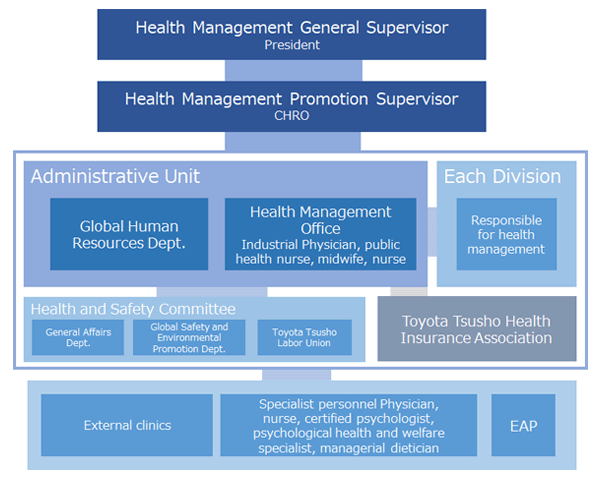
The President and CEO is the person with highest responsibility, and the CHRO(Chief Human Resources Officer) is responsible for implementation. The Global Human Resources Department, Health Management Office, and health insurance association work together, hold regular meetings to share issues and progress on initiatives, and promote health management under the framework described below.
In addition, the "Health and Safety Committee" is chaired by the CHRO, who is responsible for health and safety. The committee meets monthly to discuss employee health and safety environments; it also reports to the Board of Directors on health and safety risks, depending on their severity. "The Health and Safety Committee" is also attended by a labor union officer, who represents all employee. Together, the committee members discuss how to promote employee health, and how to develop environments in which it is easy to work.
In March 2026, Toyota Tsusho was certified as a “White 500” organization, recognized for particularly outstanding health management practices in the large enterprise category of the Health and Productivity Management Outstanding Organizations 2026 program.
Going forward, we will create workplaces in which each employee can work with vitality, leading to sustainable corporate growth.
Toyota Tsusho aims to maximize the potential of its people and organizations, enhance corporate value, and achieve sustainable growth through “Awakening of Our DNA” in each employee and the creation of an organization that is a “Thriving, Living Organism.” The well-being of our diverse human capital is essential to achieving these aims.
Our health management initiatives pursue the following two goals, integrating support for individual health with improvements in work styles and workplace environments:
Specifically, we improve employees’ health literacy and encourage proactive healthy behavior through disease prevention, medical examinations, interviews, and health consultations. We also promote flexible work styles, support employees in balancing work with life events, and encourage workplace dialogue to create an environment where people respect and support one another and can fulfill their potential.
The Health Management Strategy Map sets out how these initiatives lead to changes in employee awareness and behavior and workplace environments, and ultimately to improved presenteeism and work engagement. We have designated these two outcomes as key goal indicators (KGIs) and established medium-term targets to realize the well-being of our diverse human capital.
| index | Goal to be achieved Fiscal Year ended March 2028 | remarks |
|---|---|---|
| KGI: Presenteeism | 32.0 | Measured by WHO-HPQ |
| KGI: Work Engagement | 2.7 | Measured using two items from the New Brief Job Stress Questionnaire related to work engagement |
| "KPI: Healthy Lifestyles Challenge 8 program" | 6.0 | Survey on the number of people who have achieved eight healthy habits |
| KPI: Health literacy | 19.0 | Measured using the CCHL scale |
| "KPI: Infectious disease prevention measures" | Continuing to have zero deaths while employed | - |
| Fiscal Year ended March 2021 | Fiscal Year ended March 2022 | Fiscal Year ended March 2023 | Fiscal Year ended March 2024 | Fiscal Year ended March 2025 | Fiscal Year ended March 2026 | |||
|---|---|---|---|---|---|---|---|---|
| Consultation rate for periodic medical examinations | 100.0% | 100.0% | 100.0% | 100.0% | 100.0% | 100.0% | ||
| Consultation rate for detailed examinations | 97.1% | 95.6% | 87.9% | 85.9% | 90.9% | 89.6% | ||
| Consultation rate for cancer examinations | Gastric Cancer Risk Screening | 100.0% | 100.0% | 100.0% | 100.0% | 100.0% | 100.0% | |
| Colorectal Cancer Screening | 93.8% | 94.3% | 93.9% | 94.9% | 92.4% | 91.9% | ||
| Treatment rate*1 | Blood pressure | 90.3% | 95.1% | 98.2% | 93.6% | 95.2% | 95.6% | |
| Blood glucose level | 83.8% | 96.3% | 98.8% | 96.1% | 96.1% | 94.1% | ||
| Obesity rate | BMI more than 25 | All age groups | 23.6% | 22.9% | 24.1% | 22.9% | 24.2% | 25.0% |
| Under 40 years of age | 17.2% | 16.3% | 18.4% | 17.5% | 17.7% | 18.2% | ||
| Rate of smoking | Total | 18.0% | 17.5% | 17.0% | 16.8% | 16.3% | 16.7% | |
| Male | 25.8% | 25.2% | 23.8% | 23.8% | 23.1% | 23.3% | ||
| Female | 2.2% | 2.3% | 2.6% | 2.7% | 2.8% | 3.0% | ||
| Percentage of individuals who exercise regularly*2 | 45.4% | 47.0% | 53.2% | 55.1% | 57.2% | 58.0% | ||
| Percentage of individuals who are well-rested through sleep | 75.5% | 76.5% | 71.0% | 68.4% | 67.4% | 68.1% | ||
| Percentage of individuals who eat breakfast*3 | 76.0% | 74.9% | 73.1% | 73.1% | 74.6% | 74.6% | ||
| Stress check consultation rate | 97.2% | 98.5% | 99.0% | 98.0% | 98.1% | 98.1% | ||
| Percentage of individuals with high stress | 5.3% | 7.9% | 9.0% | 8.6% | 8.9% | 7.3% | ||
| Long working hours | Occurrence rate of overtime work exceeding 50hours per month | 2.58% | 3.81% | 3.55% | 3.43% | 4.62% | 4.01% | |
| Occupational physician consultation rate among employees eligible for consultations due to overwork*4 | 94.0% | 100.0% | 100.0% | 100.0% | 100.0% | 100.0% | ||
| Percentage of individuals taking annual paid leave | 52.8% | 57.0% | 66.1% | 62.5% | 64.9% | 66.5% | ||
| Infectious diseases seminar | cumulative number of persons | 2,600 | 2,629 | 3,424 | 3,590 | - | - | |
| Number of participants | - | - | - | - | 3,026 | 2,948 | ||
| Participation Rate | - | - | - | - | 81.7% | 77.1% | ||
| Absenteeism (percentage of individuals who were absent from work for more than 7 consecutive days due to non-occupational injury or illness)*5 | Physical | 0.12% | 0.19% | 0.25% | 0.38% | 0.23% | 0.16% | |
| Mental | 0.28% | 0.48% | 0.51% | 0.61% | 0.41% | 0.65% | ||
| Presenteeism (WHO-HPQ)*6 | 35.4 | 34.4 | 33.8 | 33.1 | 32.6 | 32.4 | ||
| Work engagement*6*7 | 2.65 | 2.61 | 2.63 | 2.64 | 2.66 | 2.69 | ||
| Implementation rate for health consultations on specified conditions | 32.2% | 51.8% | 62.8% | 67.5% | 74.1% | Under aggregation | ||
| Health Literacy*8 | - | 17.70 | 18.48 | 18.64 | 18.71 | 18.92 | ||
| Average number of Healthy Lifestyles Challenge 8 program items practiced | - | 5.57 | 5.34 | 5.51 | 5.50 | 5.58 | ||
General Comments: Improvements have been observed in the average number of Healthy Lifestyles Challenge 8 items practiced, health literacy, presenteeism, and work engagement. However, lifestyle-related challenges remain, including an increase in obesity. To translate health awareness into action and lasting habits, we provide health guidance based on medical examination results and encourage practical steps in daily life through exercise events, breakfast distribution, and visualization of sleep patterns.
We also prioritize prevention and early intervention to reduce absenteeism due to mental health issues. Alongside encouraging self-care and line care by managers, the human resources team, industrial physicians, and public health nurses work together to provide follow-up tailored to employees’ physical and mental health and their work and personal circumstances. By supporting both individuals and workplaces, we create an environment where employees can seek advice with confidence and continue working.
Analysis at the individual employee level identified associations between the number of Healthy Lifestyles Challenge 8 items practiced, health literacy, and presenteeism. Analysis of changes over time also confirmed associations between improvements in healthy behavior and health literacy and improvements in presenteeism. These findings inform the development of measures that support behavioral change and lasting habits, as well as ongoing evaluation and improvement of their effectiveness.
We combine health promotion for all employees with support tailored to individual health issues. Starting with learning about health, we encourage employees to understand their own condition, take action, and sustain healthy habits.
Our in-house newsletter, “Toyotsu News,” regularly introduces “Well Compass,” our guidelines for well-being. These articles give employees opportunities to reflect on their health and work styles and review their daily behavior.
The Healthy Lifestyles Challenge 8 program encourages employees to review and improve eight healthy habits: appropriate weight, exercise, drinking, smoking, breakfast, snacking, sleep, and stress. Of the eight healthy practices, one point is awarded for each that is practiced for a perfect score of eight points. We calculate the average employee score and use it as a health management KPI. In addition, each employee chooses an item to improve and makes a “My Health Declaration,” creating an opportunity to begin taking action that suits their needs.
In the questionnaire for fiscal year 2025, 92.6% of employees were aware of Healthy Lifestyles Challenge 8 activities, and 59.3% answered that they were taking action to improve their lifestyle habits with this program in mind. The percentage who achieved their “My Health Declaration” also increased from 51.6% in fiscal year 2024 to 58.2%.
We will continue to widely disseminate information on each of the eight habits and improve the content and delivery of initiatives to make participation easier. By translating awareness into practice and sustained action, we will support each employee in independently maintaining and promoting their health.
To prevent the occurrence of obesity-related lifestyle-related diseases, cerebrovascular diseases, and ischemic heart disease, the company places emphasis on early intervention for younger generations. Health guidance was provided to employees under the age of 40 who were at risk of metabolic syndrome, using the Lifestyle-related Disease Risk Report, which analyzes individual health checkup results through big data and predictive models. As a result, 84.4% of the target group reported being very satisfied or satisfied with the health guidance.
We continue to hold seminars by dietitians on breakfast and snacks for employees who tend to eat out and drink alcohol frequently and have disordered eating habits, and provide information via video clips. In employee cafeterias, we offer “Health Challenge Menus” with attention to calories and nutritional balance and implement meal planning initiatives in collaboration with other companies, supporting health through everyday food choices.
Through the planning of online seminars and physical fitness testing sessions, as well as regular information dissemination, we aim to deepen employees' understanding of the importance and benefits of exercise and increase the number of employees who voluntarily and continuously engage in physical activity.
In collaboration with the health insurance association, Toyota Tsusho regularly holds charity walking events that donate school meals to children in developing countries based on the total number of steps achieved. As an incentive to encourage exercise, the company has also launched an initiative that awards points according to participation in seminars and individual exercise achievements.
Together with the Healthy Lifestyles Challenge 8 items, these initiatives have gradually produced positive results, leading to an overall increase in the percentage of employees with regular exercise habits. Analysis of step counts and exercise habits showed that participants in the events increased their average number of steps by 9.5% compared with normal periods, and improvements were also observed in stress check scores and presenteeism. We will continue this activity to connect employee health promotion with social contribution.
We also measured posture and physical abilities among employees, including senior employees, and introduced exercises tailored to the results that they could begin the following day. Opportunities to understand their physical condition and learn specific ways to improve it support health promotion for employees of all ages.
To raise awareness of the importance of breakfast, we distributed convenient breakfast foods to all employees and also offered them for sale within the company. By giving employees an opportunity to try options that are easy to incorporate into busy mornings, we encourage them to put knowledge into action.
We also support healthy daily eating habits through information provided by dietitians and health-conscious menus in employee cafeterias. We are creating an environment where employees can make healthy food choices without difficulty and sustain them as habits.
We have designated sleep as a priority within the Healthy Lifestyles Challenge 8 program and are conducting a sleep survey that enables employees to visualize their sleep patterns. Based on the results, we will provide sleep seminars introducing practical ways to improve sleep in daily life.
Improving sleep requires both healthy personal habits and work styles that allow sufficient rest. We also encourage the use of the work interval system and other measures to help employees secure adequate sleep quality and duration.
To strengthen anti-smoking measures, Toyota Tsusho has implemented a completely smoke-free workplace policy and introduced a subsidy program for smoking-cessation outpatient treatment to support employees who are attempting to quit smoking. For employees who have not yet been able to take the first step toward quitting, the company provides regular informational support through column distributions and pamphlets, as well as individual consultations with public health nurses to assist self-directed cessation efforts.
As an incentive to maintain a smoke-free lifestyle, Toyota Tsusho, in collaboration with the health insurance association, offers points to non-smokers through a health-promotion app. A company-wide survey revealed that about 70% of employees who successfully quit smoking stated that these initiatives contributed to their behavioral change and encouraged them to take voluntary action.
In fiscal year 2025, the smoking rate among male employees was 23.3%, and the overall rate was 16.7%. We will continue to support further cessation efforts with the goal of reducing the overall smoking rate to less than 15% by the end of fiscal year 2027.
Taking changes in the age profile of our employees into account, we work to prevent cancer and promote early detection. Toyota Tsusho continues to provide accurate information on cancer prevention through seminars conducted by occupational physicians and in collaboration with external organizations. In cooperation with the health insurance association, the company also encourages employees to undergo cancer screenings through comprehensive medical examinations.
Toyota Tsusho conducts gastric cancer risk screenings (ABC tests) for all employees during regular medical examinations, helping employees found to be infected with Helicobacter pylori receive eradication treatment. In addition, the company supports screening through colorectal cancer screenings (fecal occult blood tests) for employees aged 40 and over and a science-based cancer screening subsidy program.
For employees diagnosed with cancer, we support a balance between treatment and work through leave that can be used for hospital visits and flexible work arrangements. We will continue to create an environment where employees can seek advice with confidence, from prevention and early detection through to working while receiving treatment.
In collaboration with the health insurance association, Toyota Tsusho encourages medical consultations and provides health guidance based on medical examination results. For eligible employees aged 40 and over, health consultations on specified conditions utilize individual medical examination results along with big-data–based simulation analyses to explain future health risks clearly.
In addition to face-to-face guidance by dietitians, we offer email and online consultations to make support more accessible. Through detailed guidance and encouragement to continue, the implementation rate of health consultations on specified conditions increased from 32.2% in fiscal year 2020 to 74.1% in fiscal year 2024. We will continue to provide health consultation in order to improve guidance rates and reduce the number eligible persons.
As mental health measures, we focus on stress caused by environmental changes such as joining a company or working overseas, as well as the effects of jet lag and fatigue associated with overseas business trips, to prevent mental health problems and provide early support. As part of our efforts to prevent mental health problems, we offer interviews with industrial physicians and public health nurses for new graduates in their first and second year of employment and career employees, and provide opportunities for them to learn about self-care and in-house mental health support.
As part of our measures to prevent overwork, we have established our own standards that combine overseas business trip history and overtime work to specially target employees for interviews with industrial physicians. Stress checks are also conducted on employees who work overseas, and employees with high levels of stress, whether in Japan or overseas, are invited to meet with industrial physicians and receive the necessary support. We also provide an external consultation service for employees and their families in Japan and overseas.
As a line care measure, we hold practical line care training for managers based on the results of organizational diagnosis. To encourage self-care, we provide mental health management training via e-learning for all employees. Through support for both individuals and workplaces, we create an environment where employees can seek advice rather than face mental health concerns alone.
Every October, Toyota Tsusho designates a company-wide Compliance Awareness Month to strengthen awareness initiatives. During this period, the company conducts an e-learning program titled “Say NO to Harassment Together” to promote the elimination of harassment and build organizations with high psychological safety. In fiscal year 2025, it also held “Training for Harassment Consultation Desk Representatives” to strengthen consultation support.
We are creating an environment where female employees can seek advice and continue working without having to face health concerns alone. We provide a consultation service for women’s health, encourage breast and cervical cancer screening, offer HPV self-sampling tests, and support employees in balancing work with pregnancy and childcare. “Ladies’ Leave” can also be used for infertility treatment.
In addition, around International Women’s Day each March, the company conducts health seminars focusing on women’s unique health issues and life stage changes. Alongside female employees, these seminars deepen understanding among male employees and managers, helping create workplaces where health concerns can be discussed openly.
Since 2024, we have conducted annual health literacy training via e-learning to deepen mutual understanding between men and women. By making videos available for a set period and continually encouraging participation, we provide learning opportunities to a broad range of employees. The program creates opportunities for dialogue across gender and hierarchical boundaries and develops a culture that recognizes and respects each other’s differences.
In developing the next generation of female leaders, the company provides both internal and external mentoring opportunities to raise career awareness, broaden perspectives, and support problem-solving, thereby fostering an environment where women can thrive with confidence and vitality. We support female employees through both health and career initiatives.
| Training name | Participation rate in fiscal year ended March 2026 |
|---|---|
| Men's and Women's Health | 78.0% |
| Women's Health | 82.5% |
| Managers Edition (for managers) | 84.1% |
We use engagement surveys to understand employees’ motivation, ease of working, and the state of our organizations. Results are shared with senior management and each workplace, and dialogue helps us understand what lies behind the scores and identify specific improvements.
In fiscal year 2025, strategy and direction and leadership were identified as strengths, while collaboration across organizations and work processes and organizational structures showed room for improvement. We view these as opportunities to improve cooperation between departments and how work is organized, rather than as individual employee issues.
Power-Up Meetings (PUM) provide one opportunity for dialogue. Away from their usual workplaces, employees exchange views openly on important themes without being constrained by job titles or positions. By listening to one another without rushing to conclusions, they deepen their understanding of workplace challenges and the organization they aspire to create.
While promoting flexible work styles through the introduction of work-from-home and flextime systems, Toyota Tsusho is also implementing various initiatives such as office reforms to revitalize communication among employees, which can become diluted under flexible arrangements. These efforts aim to foster and pass down Toyota Tsusho’s unique corporate culture by encouraging cross-organizational dialogue, casual information exchange, and mutual learning that lead to the creation of new value.
Every Wednesday is designated as “Nomad Day,” during which employees are encouraged to work in a hot-desking style across office floors. After working hours, the cafeteria space is opened for “Nomad Night,” an event designed to promote vertical, horizontal, and diagonal communication across different departments and levels.
The company also promotes a well-balanced working style through measures such as turning off all office lights at 8:00 p.m. to encourage early departure, gradually lowering the upper limit of the special provisions under the Article 36 Agreement, and prohibiting business communication in principle during late-night hours (10:00 p.m. to 5:00 a.m.) starting in fiscal year 2025. These efforts encourage employees to be conscious of how they use their time and help reduce long working hours and overtime.
In addition, Toyota Tsusho uses a work interval system to secure rest between the end of one working day and the start of the next. The company promotes the use of annual paid leave through the Monthly Paid Leave Campaign and designated days on which employees are encouraged to take paid leave, thereby helping employees maintain their health, reduce mental and physical fatigue, and improve productivity.
We support employees working around the world and their families in maintaining their health and living with peace of mind, taking into account infectious disease risks and medical conditions in each assignment location. We also draw on the Group’s business presence and networks to address health issues in the communities where we operate.
We hold pre-departure seminars and seminars for spouses to provide employees assigned overseas and their families with opportunities to learn about malaria and other infectious diseases and local health management. To protect employees who may travel or work overseas, we launched infectious disease seminars in fiscal year 2017, with a total of 3,590 participants by fiscal year 2023. In fiscal year 2024, the program content was revised and moved to e-learning. Around 3,000 employees, including those working overseas, participate each year, updating their knowledge of infectious disease prevention through ongoing learning.
During pre-departure medical consultations with occupational physicians, employees’ travelers’ vaccination histories are checked and advice is provided based on their destinations. Records are stored in medical charts and used for ongoing health management. We actively promote vaccinations against infectious diseases for not only persons assigned overseas but for family members accompanying them as well as business travelers.
Using information provided by the Ministry of Foreign Affairs, International SOS, Control Risks, and other sources, we communicate the latest information regarding infectious disease outbreaks in Japan and overseas and vaccinations that may be required at employees’ destinations. We also inform employees of specialized medical facilities near our domestic sites so that they can promptly seek medical care if they develop symptoms such as fever after returning to Japan.
| Name | Training Contents | Number of participants in Fiscal Year ended March 2026 | Participation Rate in Fiscal Year ended March 2026 |
|---|---|---|---|
| Infectious Diseases Prevention Seminar | Education on the risks of malaria and other infectious diseases and health care while working/traveling abroad | 2,948 people | 77.1% |
*Excluding spouse
Prior to overseas assignments, industrial physicians and public health nurses meet with all employees scheduled for overseas assignments to determine whether or not they can travel and to confirm their physical and mental condition prior to the trip. During overseas assignments, Toyota Tsusho requires employees to undergo annual medical examinations. All results are reviewed by occupational physicians, who provide individualized guidance and alerts based on specific medical risks in each country or region. Employees identified as high-risk in terms of health management or working under high-stress conditions receive continuous support, including regular online consultations.
In addition, industrial physicians and overseas staff in charge of health management regularly visit the workplace to check the actual working environment, sanitary environment, and medical system. The Health Management Office and the external EAP (Employee Assistance Program) provide day-to-day consultation services. We also support employees working overseas and their families in cooperation with overseas corporate office staff and local medical assistance companies.
For example, in response to the serious social issues of HIV/AIDS and malaria in Sub-Saharan Africa, Toyota Tsusho provides prevention, testing, and treatment programs for employees and their families working in the region. CFAO, which operates across all 54 countries in Africa, carries out initiatives under the banner of “Health by CFAO,” addressing diseases such as HIV, diabetes, malaria, hypertension, and tuberculosis through awareness programs, prevention efforts, testing, and guidance.
The Toyota Tsusho Group believes that contributing to the local communities in which it operates is an essential part of achieving sustainable development together.
As a company conducting business in regions with high risks of HIV/AIDS, tuberculosis, and malaria—the world’s three major infectious diseases—Toyota Tsusho undertakes activities to support the health of local residents as well as employees and their families.
Toyota Tsusho invests in employee health through initiatives that deepen health awareness, prevent disease, address individual health issues, and improve workplace environments. Investment in health initiatives in fiscal year 2025 totaled approximately JPY 50 million.
